Starting a new political party
Article posted by Unlock Democracy
DISCLAIMER: This article contains the personal views of the author and should not be inferred to be the views of Unlock Democracy.
By David Woods (Your Party).
Why the need for new ideas?
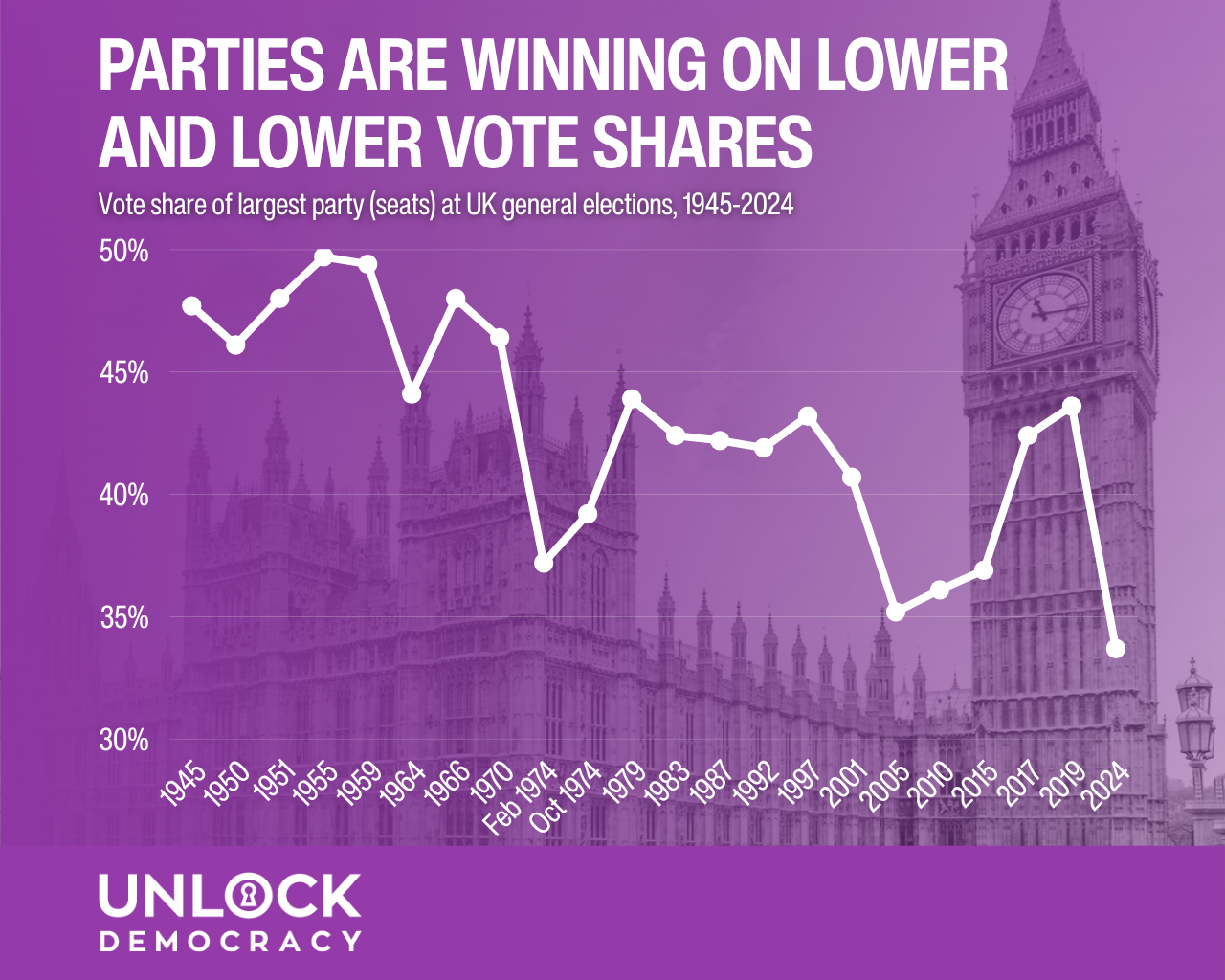
In political circles, much is made of decreasing turnouts and increasing voter apathy. These are undoubtedly a threat to a healthy democracy and yet, when you talk to people, these are not the problems they mention. People’s concerns relate to crime and anti-social behaviour; to the health system; to education; to a range of other issues. Voter apathy is not seen as a problem in itself – it is a symptom of a broader problem.
That problem is, for many people, a perception that government – national and local – simply doesn’t work. It costs a lot of money and it doesn’t deliver on the issues that matter to people. Politicians – the most visible representatives of that governmental system – are widely distrusted and disliked.
Apathy is not a lack of interest in issues – it’s a lack of trust and belief in politicians and the political process. (In fact there is evidence that people’s involvement in issues has never been higher; just as membership of political parties has never been lower.)
This perception of government and politicians may not be entirely fair. There are plenty of well meaning people who have entered politics – and most people can think of something that the government has done that has improved their lives. However, at some level, people are right. The issues that are with us today aren’t new ones. The overall level of quality in education has been far too low in this country for far too long. The level of crime has also been far too high for far too long. And this despite the countless hours and billions that have been spent on these issues.
The standard party political view is that, if only they were in power, these problems would all be magically solved. However, this flies in the face of all the evidence of the past decades that political parties, even when they are in power, can’t in themselves solve society’s issues. If they could, surely by now one of them would have hit on the right solutions and dealt with our problems?
With all this evidence, the question has to be asked: How likely is it that the current system of party politics will deliver real lasting solutions? Politicians’ speeches, point scoring in Prime Ministers question time, MPs who vote according to weekly instructions from party whips, even the passing of yet another law – does any of this really deliver? Does the average person even know or care about all this activity? Who, honestly, changes their behaviour as a result of a politician’s speech?
The recent shenanigans over Labour’s poster campaign highlights the adversarial nature of party politics where childish putdowns take precedence over policies, and ideas from other parties are opposed, regardless of merit. The party political system is not sufficiently open and transparent, does not engage stakeholders or intellectually develop policy with everyone having a sense of involvement in the decision making process. It is tribal government, and a far cry from an honest system where decisions are taken on factual merit.
Your Party believes it flies in the face of all the evidence to believe that the current system will deliver positive change. Society is not the army – it is not enough to issue an order at the top and expect everyone to believe in or follow it. Change happens because society as a whole decides it wants change. Politicians can, of course, help – and even lead that change. But it only actually happens when society decides so.
The new idea
‘Your Party’ was founded in January 2004 with the intention of creating a system where politicians voted in line with the public’s wishes after a full debate of the issue in question. It would start with no bias about the best way forward in the future but would seek to find common ground between citizens of all persuasions. It’s hoped that Your Party will tap into the huge pool of ideas that exist in the minds of the public but that never have the opportunity to get voiced at a national level. Your Party also believes that by properly representing their constituents, politicians will gain more trust with the media and public and that genuine debate will replace spin and adversarial politics. The rise of internet use presents a new opportunity to engage voters, canvass opinion and undertake voting in a scale that was previously impossible without great expense.
Your Party believes that society, like any other organisation, works best when people are engaged and involved in identifying both the issues and the solutions. That those solutions are much more likely to be of high quality when benefiting from the input from a wide range of society – not just three people with the Prime Minister’s ear. That those solutions are much more likely to be implemented when people have a sense of ownership, rather than a sense of imposition.
Your Party wasn’t set up because the world needs another political party. It was set up to help change the system to one that delivers high quality, effective solutions to the issues of today. Your Party would gladly work with and give its support to any major party that adopted this system, and would consider its mission accomplished if that were to happen.
The practicalities
There were a number of structural practicalities involved in setting up a political party that had to be addressed – appointment of the board; registration with the electoral commission; whether to charge for membership and/or the right to vote; authentication of voters and security of the voting mechanism; writing the constitution; building the website; how to appoint/elect our candidates and how many seats to stand in – to name but a few.
The most difficult aspect of a setting up a participatory political party is, without doubt, policy forming. How do you promote a party that has no policies? And how do you form credible policies with a party that has a relatively small initial membership? At what point do you start forming policies? How do you form policies that work as a coherent whole and don’t contradict one another? How do you form policies full stop? These remain difficult issues.
The best solution to most of these problems is to treat each constituency as a unique entity and allow the representative to lead on each policy with their views. They would say “I intend to vote this way on this issue for these reasons – what do you think?”. If, a percentage of constituents registered their disagreement, the decision on whether to back the MP’s views would go to a formal constituency wide vote and the MP would be obliged to follow that decision. Each constituent would also be free to make policy proposals, which would also go to a formal vote if sufficiently backed. The trigger threshold for a full vote would have to set the right balance between involving all constituents and avoiding voting overload. Most people have little interest in the vast majority of bills that are passed, though this process would help raise the awareness and put the issues into the public arena.
Experts in particular fields could recommend policies and provide neutral evidence to inform the electorate. Appropriate issues could be decided by national referenda. No-one thinks the electorate can be closely involved in setting every line of the budget; however, government’s spending and taxation plans
can reflect the priorities of the public.
There are, perhaps, valid concerns about how this system could work as a cohesive government. However, even a small number of MP’s working in this way would make a tremendously valuable input into the decision making process and partly redress the current imbalance of power between politicians and the public. A good working model could be developed over time and any issues could, eventually, be resolved.
Another significant obstacle was the lack of any software that would allow our members to form and vote on proposals. In the end we have written our own design for a system that meets our needs and the development of version 1 is almost complete. The software, or “Community Voting Toolkit” as we have called it, is designed to be flexible and will allow both representatives and constituents (and/or any members of the community using the toolkit) to propose policies and subsequent amendments. Once a policy has been ‘posted’ all constituents and representatives will be able to comment on it and add proposals for amendments and the amendments can be ranked.. Once a policy has been posted for a sufficient period of time, and all amendments voted on, the policy will move to the official voting phase where all the constituents can vote to approve it or not. The administrator can set the thresholds required and the system also allows for ‘multi option’ proposals where constituents can select 3 out of 5 options, for example. Other voting mechanisms can be plugged into the software.
What worked?
The launch PR resulted in a number of articles (including the Observer and the BBC website) and radio and TV interviews which generated a lot of interest. We received over 1500 responses to our survey and 500 people registered an interest in standing as a candidate. We have also consulted our newsletter subscribers on a number of issues. This has thrown up dozens of useful suggestions, and, when we’ve held informal votes, we’ve found their aggregated responses to be eminently sensible.
We’ve spent many hours interviewing people on the streets and found almost unanimous support for giving the public real power in the decision making process (as apposed to just being consulted). We’ve also found most people to be concerned about at least one issue and their responses to be mostly well considered and informed.
Perhaps the most valuable thing we’ve got from this first year is a much better grasp of the political process and a much better understanding of those aspects of the current system that need to be changed. We began 2004 as political novices, and, while certainly no experts, we entered 2005 a lot more informed.
What didn’t?
The first few months of Your Party, like any new project, suffered from an underestimation of the work required and an overestimation of how easy it would be to get publicity and gather solid support. The initial intention to be ready to stand in the European elections was naïve, and our members agreed we should wait until we were better prepared. We have also found it very difficult to convert emailed offers of help into genuine assistance, though this shouldn’t negate the valuable input of many of our subscribers who are willing to provide their views and ideas via surveys and online discussion groups. All the founding members of the party are based in London and, despite our best intentions and efforts, it has been difficult to establish the momentum for regular meetings elsewhere.
We have also received and taken on board a lot of constructive criticism of the original Your Party concept. Many people found the idea of pure direct democracy a little too radical and, as discussed earlier, we now believe that representatives should provide a much greater degree of leadership
What next?
We are well aware of the difficulties faced by small parties and, as a result, we are launching a new initiative – the Independent Network – a support organisation for dozens of established smaller parties and independent politicians. IN will provide logistical, legal and technical support to groups and individuals that sign up to a basic set of principles and provide opportunities to join forces where goals are shared. Small parties and independents often struggle with a perception of insignificance and we hope a national structure and shared campaigning tools will make them more electable. The initial response to this idea has been extraordinary.
We will be releasing our policy forming software in the next few months and hope to trial it in a number of institutions as well as political parties. We’ll also be contesting a small number of seats at the general election under the Your Party banner, including Holborn and St Pancras.
This allows us to focus all our resources in a small area. We are also conducting extensive research in Holborn & St Pancras , and will represent the constituent’s views to the people that can do something about them. Standard consultation exercises are fine but will run the risk of being dominated by special interests and those people who respond to such exercises. Most street campaigning tends to focus on trying to persuade people that they should vote for a particular party. We think it is important to proactively go out, engage with people, find out what their concerns are and truly represent all of society.
Building Your Party has been, and continues to be, a rewarding and exciting experience. With advances in technology we remain certain that participatory democracy is the future of politics, and that society will adopt the idea in time.
For further information about Your Party; visit www.yourparty.org or call 0845 4560261.
Responses to this article:
Representatives from the Labour Party and Conservative Party were invited to submit responses but declined to do so.


April 4th, 2005 at 8:00 pm
WE have the same apathy here in Canada, for the same reaasons.Australia has the answer to that with a decent fine if one refuses to vote. Presumably if one has to vote, on time reason will prevail on the refusers when they start to become politically conscious and perhaps just a little bit less selfish.
April 5th, 2005 at 9:27 am
How about a system which actually is truely democratic? Our party political system clearly isn’t and people are out of touch on both levels. Westminister and the general population.
The current party system has run out out of ideas and needs to change before people will feel that it is representive…At this point more people might vote. The most common cause of voter apathy is the idea that nothing changes anyway so why bother?
April 5th, 2005 at 7:01 pm
I believe that antipathy is more applicable to low voter turnouts.
I certainly always vote but as I have never felt that I have ever been represented
I vote for a fringe party such as the monster raving loonies.For a more detailed
explanation see William Lovett circa 1836.
April 10th, 2005 at 10:55 am
I think the aims of Your Party are admirable, but the description of the methods required shows that it is not a practical way of involving ordinary people. It is also far too vulnerable to excessive influence from pressure groups. Worse still, it tends to undermine existing parties which support some of your aims (such as the Liberal Democrats) which have a better chance of puting them into practice.
August 20th, 2005 at 7:17 pm
Having 1 vote every 4 years isn’t really democratic and neither is compulsory voting.
I would happily support any organisation that can give people the option to vote on more things if they want to.
With the kind of people power described in this article things like the congestion charge wouldn’t have happened and furthermore we could vote to resolve London’s congestion problems by removing traffic lights and re-opening all the closed roads… ect, ect… and if you happen to be one of those people who think the congestion charge is a good idea then you can vote to keep it or even generate support to extend it. Makes good sense to me.
September 7th, 2006 at 3:47 pm
My gripe with todays politicians is the way they seem to deliberately undermine the electorate.For
instance,We were fed the line that the war with Iraq was about overthrowing a tyrant, when, in reality
there are far more agendas which we will never be privy to.I’m all for overthrowing oppresive
governments but why only Sadddam?There are unspeakable cruelties happening to peoples the world
over which our government could and in my opinion should tackle.In Africa and in Central America
I have read and watched features recently which as a human being I found extremely upsetting.I’d like
to see a party which is more open and who will address the issues that the eloctorate constantly
identify every day.Especially law & order which for a civilised nation is spiraling to a level
completely unacceptable.Give us the confidence to walk our streets without fear.Maybe then we can
come together as a nation and set about helping each other & others the world over.
July 6th, 2008 at 4:15 pm
A great man once wrote;
It is simpler to make clear that which we do not favour than waste time deciding what we wish in it’s place”.
Politicians will take no notice unless they bel;ieve their policitical futures are threatened.
Vote for NONE of the ABOVE would be a very simple campaign / catchy & newsworthy (copy of the Richard Prior Movie – which describe very apt motives for teh campaign).
Let them know that we have at the moment is not the way to go – perhaps we may even get some change (who knows).
In any case – I very much support what you are trying to achieve.
S
November 6th, 2009 at 11:15 pm
there is no true party for the poeple 65% dont vote i have more answers than most politicians okay not the public education but how many in this country have, i do have unbiased ideas and it will benefit all colours and creed , as we are multi rational country , we need realistic society that benefits the true and honest , that are being ripped off and pushed aside , for the greed of the people we supposed to trust , there is too much money involved in all our world and thats where is half the problem
December 14th, 2009 at 12:36 am
[...] I’ve recently started collaborating with Dave Woods & Dan Thompson, founders of Your Party, and Brian Ahearne of Independent Network to use technology to help improve our elected [...]