Elections are the basis of any democracy. It is essential that people are able to vote without their vote being stolen, that their vote counts, and that the election cannot be bought by wealthy individuals or groups.
A Proportional, Open Electoral System
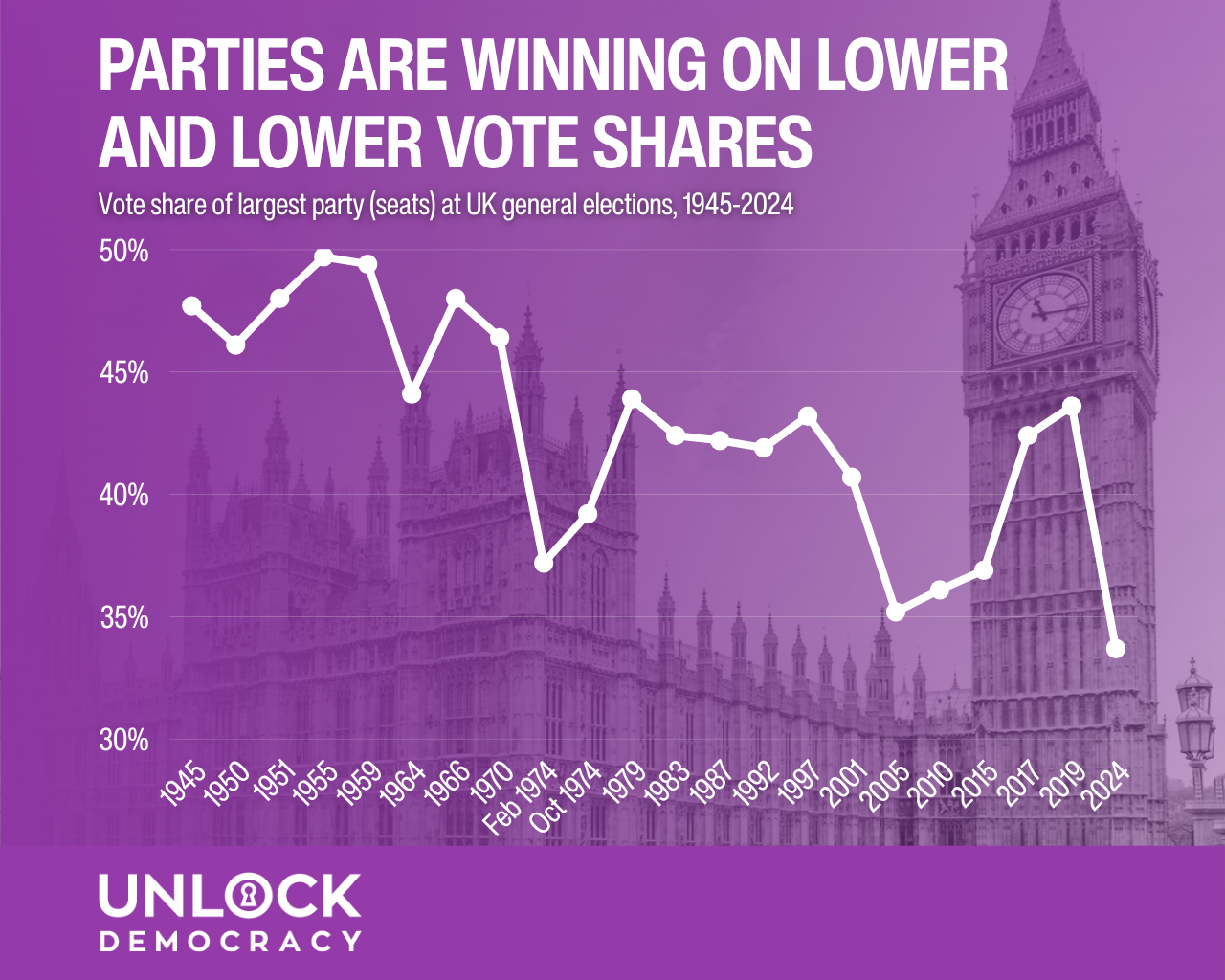
This general election could be decided by as few as 35,000 swing voters in 75 constituencies. Under our current electoral system most votes either do not elect anyone, or pile up in safe constituencies above the level needed to win that seat, so count for nothing.
All UK elections should offer real choice and fairness. No politician should be able to rely on their party finding them a safe seat. We want:
- A proportional electoral system that broadly reflects the votes cast for each party in an election, but also allows voters to support specific candidates and not just party lists.
- Voters to have the right to force a referendum on whether to recall their elected representatives and force a by-election.
Preventing Voting Fraud
Elections must be trustworthy. Those casting votes must be entitled to do so and votes must not be stolen. We need:
- Individual voter registration. The planned transition from our current flawed system of household registration must be fully
funded by central government. - Voters to prove their identity. We believe that voters should provide evidence of identity (e.g. credit card, passport or driving icence) when voting.
- A statutory obligation for the Government to respond to Electoral Commission recommendations. They should be compelled to formally respond within six months.
Party Funding Transparency and Caps on Funding
Money can have a powerful effect on the outcome of general elections, particularly in marginal constituencies. The perception that
money can buy influence, policies and even peerages is corroding UK politics. We need to:
- Halve the current cap on national spending for each party.
- Cap donations at a low level such as £10,000.
- Regulate donations from companies to ensure that the money does not come from a foreign or other illegal source.
- Ensure trade union donations are linked to individuals by having an ‘opt-in’ box on membership forms.
Record of Action
Our predecessor organisation Charter 88 helped set the agenda for electoral reform. In 1999, the first European Elections using proportional representation were held and proportional systems are now used for the Scottish Parliament, Welsh Assembly, London Assembly and Scottish Local Government (Northern Irish institutions have used the Single Transferable Vote since 1973).
In recent years, the New Politics Network has lead the debate on party funding in the UK, making the case for a package of reforms including caps on donations and expenditure coupled with incentive-based state funding to encourage parties to engage with the electoral. Our research has proven highly influential on the position of both the Electoral Commission and the Hayden Phillips Review.
See Also